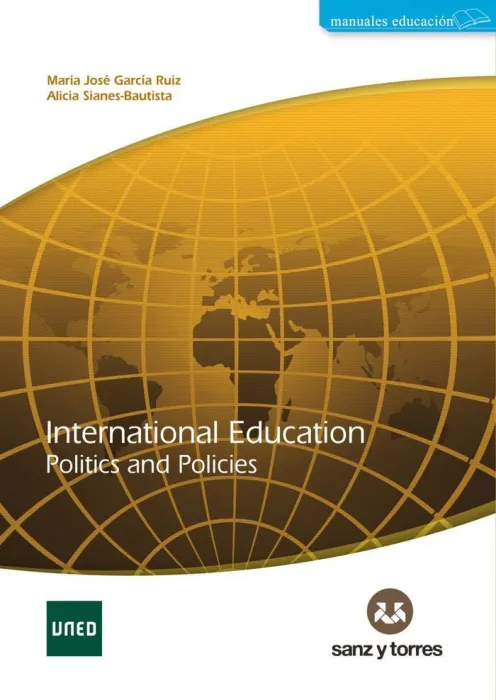
International Education
Garcia Ruiz, María José
The pace at which geopolitical changes have occurred in the 21st century is undoubtedly vertiginous, and the framework behind those changes is progressively getting more complicated than ever before. This can be explained by the rise and development of two cultural and social phenomena that have been determining the development of the western world since the 20th century: globa...
Sinopsis
The pace at which geopolitical changes have occurred in the 21st century is undoubtedly vertiginous, and the framework behind those changes is progressively getting more complicated than ever before. This can be explained by the rise and development of two cultural and social phenomena that have been determining the development of the western world since the 20th century: globalization and postmodernism. In addition, the rise and intensification of social and ideological polarization in several different parts of the world reinforces the urgency of supporting education that encourages students to develop critical thinking, global empathy, civic engagement and global citizenship. This is the main goal that the authors of this book pursue: to encourage students to be analytical, to be reflective, to be (self)critical, to be decisive, to be able to learn from the past and develop skills that allow them to both understand the world and be an active part of it. Along the same lines, education professionals -teachers, pedagogues, social educators, social workers, educational inspectors, education policymakers...- must play an active and decisive role in this world from an educational perspective. In summary, this subject focuses on the study and critical analysis of key elements of international education that have suffered and experienced the impact of many of the aforementioned transformations in the last decades.
Educational policies and politics together constitute a broad field of expertise that encompasses both great intellectual endeavour and complexities. The terms «policy»and «politic»have sometimes been erroneously used as synonyms (i.e., in Spanish there is only one term to refer to both: política). There are, in fact, essential differences between them. In the case of policy, it can be defined as «a set of ideas or a plan of what to do in particular situations that has been agreed to officially by a group of people, a business organization, a government, or a political party»(Cambridge Dictionary, n.d., definition 1); whereas politic can be defined as «wise and showing the ability to make the right decisions»(Cambridge Dictionary, n.d., definition 1). That is to say that, while policy is an abstract concept related to theories, documents, reports, etc., politic describes focused decision-making processes and actions.
This book is consists of four different chapters: 1) Comparative Education, modernity and postmodernity; 2) Tradition versus reform in education during the 21st century; 3) The recurrent debate of comprehensiveness versus stratification in the 21st century; 4) Higher education in Europe: traditional models and the impact of transnational educational trends. At the end of every chapter there is a section that summarises some of the main ideas of the chapter. In addition, students will find a glossary of terms used in this book that will help them understand both the main and secondary keywords and ideas, some recommendations for further reading, and questions for debate that will invite them to reflect on some of the contents explained in the different book chapters.
The first chapter, entitled Comparative Education, modernity and postmodernity, is an introductory chapter to the main ideas and topics on which other contents in posterior chapters will be based. First of all, the complexities within the phenomena of globalisation and postmodernism will be addressed in order to contribute to the understanding of their impact on many areas and stages of education. In addition, the relationship between both globalisation and postmodernism and International and Comparative Education will be explained. In the end, students will familiarise themselves with the aim and current scope of the discipline of International and Comparative Education, as well as new challenges and opportunities for its further development.
The second chapter, entitled Tradition versus reform in education during the 21st century, focuses on the analysis of three principal topics: lifelong learning, traditional versus progressive pedagogies, and the generation of knowledge in the 21st century. The section related to lifelong learning provides a historical approach to this paradigm, including its definition, origins and development up until today. In addition, the role of international organisations in relation to it will be explained (especially focusing on the UNESCO and OECD, respectively), and future perspectives of lifelong learning. The section that follows delves into the analysis of both traditional and progressive pedagogies, as well as the innumerable debates behind the implementation of one or the other. The last section will address the problems regarding the generation of knowledge in current times. In order to do so, Modes 1 and 2 of generation of knowledge will be described together with the impact on the generation of knowledge at universities. Then, the role, the ethical use, and multiple controversies in relation to the use of artificial intelligence in the generation of knowledge will be explained as well. In the end, concerns and interest for the future will be shared.
The third chapter, entitled The recurrent debate of comprehensiveness versus stratification in the 21st century, begins with the explanation of the principles of both equity and freedom in education and their varying impacts on comprehensive and stratified education. Afterwards, the text will continue focusing on explaining what can be understood as comprehensive education from a historical and a comparative perspective. In order to do so, examples of how comprehensive education has been implemented in different countries will be provided. In the end, the stratified education model will be explained as well, together with another example of how stratified schooling is currently implemented.
The fourth chapter, entitled Higher education in Europe: traditional models and the impact of transnational educational trends, specifically addresses the problems and crisis that higher education and especially universities are currently going through. In order to do this effectively, it will be necessary to explain in the first place the particularities and signs of identities of those European higher education models that have been more emblematic and paradigmatic in this continent. Then, the impact and effects of globalisation on European higher education and its connection with the crisis of university will be explained. In the end, some ideas regarding the future of higher education will be outlined, as well as some challenges and opportunities for growth.
One of the limitations of this book is the Europeanist approach that has been criticized for so long in the world of International and Comparative Education. In other words, the international perspective in this book is mainly focused on the western realities -especially, European-. The authors of this book are aware of this but, at the same time, providing students with a well-rounded approach to the international impact of educational politics and policies in other continents would have been too ambitious, mainly for two reasons: On the one hand, «International Education: Politics and policies»is a 6 ECTS optative subject for undergraduate degrees (Bachelor in Pedagogy and Bachelor in Social Education). That is to say that the time necessary to cover everything properly would be very tight, and the level of specialization required in this subject must be in harmony with that of a bachelor's degree and not a master's degree. On the other hand, those students who show interest in gaining a deeper and further understanding of these topics and getting to know other international realities aside from the European one will have the freedom, academic guidance, and support of teachers to delve further into information related to international education as well as their politics and policies through the elaboration of voluntary or complementary PEC (Pruebas de Evaluación Continua).
From the point of view of the authors of this book, learning about the impact of educational politics and policies from an international perspective is a key tool that will lead students towards the development of the necessary skills that will enable them to understand and adapt themselves to the complexities arising from international problems from an inclusive and collaborative perspective.
Comentarios
Sé el primero en comentar este libroArtículos relacionados